Showing posts with label US politics. Show all posts

Tuesday, May 24, 2011

To vacation, or to work

My definition of seasons is closer to the meteorological definition than the calendar definition. But not completely.
I have determined that, in Wisconsin at least, summer runs from the Memorial Day weekend to the Labor Day weekend, fall runs from after Labor Day to the Thanksgiving weekend, winter runs from Thanksgiving to Easter, and spring runs from Easter to Memorial Day weekend. (Which means that we had a really, really, really long winter this year, but you knew that already.)
That means that summer is beginning at the end of this week. School is a couple of weeks away from ending for the school year, depending on how many snow days you’ve had.
That brings thoughts of vacation for kids. And for the news media, that brings stories asking why Americans have so little vacation compared with other countries. CNN.com frowns:
Besides a handful of national holidays, the typical American worker bee gets two or three precious weeks off out of a whole year to relax and see the world — much less than what people in many other countries receive.
And even that amount of vacation often comes with strings attached.
Some U.S. companies don’t like employees taking off more than one week at a time. Others expect them to be on call or check their e-mail even when they’re lounging on the beach or taking a hike in the mountains.
(One wonders what CNN’s vacation policy is for its employees.)
This question has economic impact in Wisconsin. The license plates may say “America’s Dairyland,” but tourism is one of the state’s top three employers, and most of that tourism spending is coming up. (For proof, watch Illinois travelers try to navigate around the U.S. 41 construction in Oshkosh this weekend.)
This kind of story presents enormous opportunities for America-bashing among Americans. Someone namedNomadic Matt, writing about why Americans don’t vacation overseas, managed to bash government, the media and ourselves in just two paragraphs:
Americans are just scared of the world. I mean really scared. Maybe even petrified. In this post-9/11 world, Americans have been taught the world is a big scary place. There are terrorists outside every hotel waiting to kidnap you. People don’t like you because you are American. The world is violent. It’s poor. It’s dirty. It’s savage. Canada and Europe are O.K. but, if you go there, they will still be rude to you because you are American. No one likes us.
Even before 9/11, the media created an environment of fear. If it bleeds, it leads right? Prior to 9/11, the media played up violence at home and abroad. Pictures of riots in the foreign streets, threats against Americans, and general violence were all played up to portray a violent and unsafe world. After, 9/11, it only got worse. Politicians now tell us “they hate you” as former NYC mayor, Rudy Guiliani, did during his campaign. It’s US vs. THEM!!!
Those two paragraphs border on parody, but they’re not without some validity. It is true that Americans are much less multilingual than other countries. (Our French foreign exchange student, who leaves today, speaks at least four languages.) Government’s efforts to protect us from the next 9/11 — the Patriot Act, color-coded terrorism warnings, the fourth-degree sexual assault gang known as the Transportation Security Administration — have not made Americans feel safer,  have they? For whatever reason(s), the adventurous spirit that propelled our ancestors to leave their homes for an uncertain future in the New World has been replaced by a desire for familiarity and security, financial and otherwise. (Of course, the prevalent attitude in Europe seems to be that every American has shot at least one other American in the past 12 months, so fear based on ignorance is not unique to this country.)
Americans are accused of believing the world revolves around this country. That’s because … the world doesrevolve around this country, like it or don’t. Combine military, economic and political power, and the U.S. is still number one, like it or don’t. The number of people trying to move to the U.S. far outweighs the number planning on permanently leaving.
Nomadic Matt refrains from America-bashing long enough to point out:
Most family vacations in America are to other parts of America. Why? Because the U.S.A. takes up a whole continent and we have all the world’s environments in our states. Need beaches? Head to Florida. The tropics? Hawaii. Desert? Arizona. The cold Tundra? Alaska. Temperate forests? Washington. This attitude is best summed up by a response I got from a friend in Iowa: “Why would you want to go to Thailand? It’s far and scary. If you want beaches, just go to Florida.” Americans simply don’t see the need to go anywhere else when they can do it all in their country …
One difference between the U.S. and the rest of the world is the latter’s dependence on mass transit. In this country, the largest percentage of vacations are by family car. As much fun as, say, buying a Porsche and opting for European delivery would be, the number of Americans who drive on an overseas vacation is quite low. (Probably due to the stories others will tell you about the quality, or lack thereof, of other countries’ drivers.) So if you travel outside the U.S., you are dependent on the train or bus travel schedule, in addition to the airlines’ travel schedule. (And those who fly on business will tell you the more you fly in the post-9/11 world, the less you like the experience.) A lot of Americans prefer transportation independence.
More generally, part of the reason Americans vacation less, I believe, is genetic, believe it or not. Our ancestors came to this country to better themselves. Those Europeans then and Latin Americans,  Asians and other minorities now who come here believe they will have better lives here than where they came from. What that does equal? Work, including more than one job in many cases. Those not interested in improving their lives (perhaps because they felt their lives were pretty good anyway) never came here.
Related is the concept that Americans like to work. One reason to go into business is to make more money (you hope); another is to be more in charge of your own destiny. Another is to be able to do what businesses do in the places where they have facilities — serve their customers, employ people, and contribute to their communities. As the CNN story admits:
Working more makes Americans happier than Europeans, according to a study published recently in the Journal of Happiness Studies. That may be because Americans believe more than Europeans do that hard work is associated with success, wrote Adam Okulicz-Kozaryn, the study’s author and an assistant professor at the University of Texas at Dallas.
“Americans maximize their… [happiness] by working, and Europeans maximize their [happiness] through leisure,” he found.
I assume that part of the harrumphing about us not-enough-time-off Americans has to do with your attitude toward not just work, but your current work situation. (I came to the conclusion that most journalists are anti-business because, well, as a work environment journalism puts the “fun” in “dysfunction,” and journalists probably assume that most workplaces are like theirs.) If you’re not doing what you want to be doing, or if you’re in an undesirable work environment (however you define that), or if you feel undercompensated (however you define that) for your work, then you’d probably prefer to be anywhere else other than work.
One reason I have not been sympathetic to public employee unions in their attempted coup d’etat to reverse the Nov. 2 election results is because of the number of business owners I know. Most businesses don’t have many employees, and making a profit (the most important thing, the thing without which nothing else happens, for any business) is hard. Unlike public-sector employees, business owners’ work hours vastly exceed 40 per week. They work nights and weekends and holidays. Their employees get vacation time; they often don’t, or if they do, they are the ones emailing and calling back to the office.
Another reason for lack of vacationing that parents figure out is the cost, in numerous ways, of vacations. Much, but not all of it, is financial. On the one hand, for parents to go off on their own vacation and leave the kids with someone else seems irresponsible. But given the bickering that takes place among our children on a typical day, to be blunt the idea of listening to their arguing for several days with no alternative outlet for the adults — you can’t tell the kids to go outside when you’re in a van between destinations — doesn’t sound very appealing. (How my parents put up with that with my brother and me is beyond my ability to comprehend.) Even if the kids get along, based our experience from a three-day wedding trip to Indiana last year, American military units have an easier time deploying than our family does going anywhere overnight. Vacations are really for the kids, not the parents; put another way, parents never get real vacations until the kids leave home.
In the current economy, the tourism industry has promoted the concept of a “staycation.” Even before today, I’ve taken weeks of vacation without planning on a major trip. And other than not having to get up to go to work, I can’t endorse the concept, seeing as how that kind of “staycation” inevitably involves doing things you haven’t previously had time to do (usually some kind of house project), or taking the kids someplace you wouldn’t otherwise choose to go.
The stereotypical school summer vacation — days where nothing other than lunch and dinner is on your schedule — is disappearing for kids, too. Those who believe Americans don’t get enough vacation time are countered by those who believe that American students aren’t in school enough. Chinese students are in school about a month longer than Americans, and the Japanese school year runs from April to March (with breaks between trimesters). Throw in where American students’ test scores compare to other countries’ students, and the conclusion is that more time in school would equal better test scores. (That is an assertion not necessarily proven by evidence, similar to the assertion that more money spent on schools is supposed to lead to better results.)
Our kids’ summer schedules include summer school, baseball, Scouting summer camps and trips to grandparents. (All except the first by their choice, I point out.) Wisconsin summers are so short that if I were to travel outside the U.S., I would (1) want it to be during a period of usually crappy weather here (2) in a place that has better weather than here. And that runs smack into school for the kids.
Economists will tell you that there are always trade-offs. Having children is the largest trade-off, a trade-off the scope of which no parent-to-be realizes. That trip where you and your significant other jet-set yourselves through Europe? Not happening in your lifetime, mom and dad. Home ownership is much more valued in this country than in other countries; the trade-off is that frighteningly large number that represents the sum of 360 house payments. And many trade-offs are trade-offs you don’t even realize you’re making at the time. While I would never argue against the value of going to college, there is that matter of post-graduation student debt, which encourages graduates into the work world as soon as possible.
And what if you actually like your work? (I wrote three years ago that you should never love your job, because your job doesn’t love you.) Supposedly on our deathbeds we won’t regret not having working more. But many business owners I’ve met over the years don’t believe they’ve worked a day in their lives; that’s how much they enjoy doing what they do — serving customers, seeing the people they’ve hired grow in their skills and accomplishments, being able to make a positive difference in their communities, and so on. Employment is a two-way street — no one is entitled to a job, and certainly not a particular job; but no employer is entitled to a specific employee either.  Each has to agree to meet the needs of the other; when that doesn’t happen, either an employer excuses an employee from further work, or an employee leaves for a better opportunity.
If you think you get too little vacation time, maybe the problem isn’t in your vacation time, but in your work.

Wednesday, May 18, 2011

When I started opposing the drug war

As I age, I’ve discovered that I am prone to getting sinus infections from the bug du jour, from things growing, or from wherever else, thanks probably to my amazing luck in inheriting bad sinuses from both of my parents. I rarely go to my doctor for treatment, because I don’t believe in running to doctors every time I get a malady, and I certainly don’t believe in taking antibiotics to fix every cold I have.


The only thing that provided real relief for my sinus maladies is pseudoephedrine, found in such products as Sudafed, Mucinex D and Claritin. I’ve tried several alternatives, but products with pseudoephedrine are the only thing that allows me to breathe without causing excessive drying (a problem for those of us who wear contact lenses), or the other effects of antihistamines. Pseudoephedrine has been used for years for those who suffer from allergies and prefer not to take medications that induce drowsiness.


But pseudoephedrine is one of the ingredients of methamphetamine, thus requiring, in the mind of legislators continually running for reelection, bold and decisive action to prevent the ill among us from getting relief without running to the doctor … I mean, to protect us citizens from the scourge of meth-heads invading Wal–Mart for ingredients for their next fix.


2005 Wisconsin Act 14 requires that pseudoephedrine be sold only by pharmacists or employees working under registered pharmacists, and that no one can purchase more than 7.5 grams within a 30-day period without the approval of a physician, dentist, or veterinarian. The pharmacy is required to get photo ID from the buyer, and must record the buyer’s name and address and how much he or she purchased; those records must be kept by the pharmacy for two years. Similar legislation was passed by Congress as part of the renewal of the Patriot Act in 2006.


This law — unanimously passed in the Senate and passed 92–6 in the Assembly, which means there is bipartisan blame — is an inconvenience, to say the least, to the ill, in addition to being a burden on business. In the week I started at Marketplace in 2008, I (1) was barred from purchasing the correct medication because the pharmacy was closed even though the store was open; (2) had to have my wife get it with the usual legal third degree, and (3) stood in line at another pharmacy with other sick people so that I could buy a medication that does not require a prescription. Can’t sleep because you can’t breathe? To quote a former coworker of mine, then it sucks to be you.


I suppose I should be grateful that I can still get pseudoephedrine, since Oregon, where this began, makes pseudoephedrine available only by prescription. As it is, cold medications with pseudoephedrine are now not available in any store that doesn’t have a pharmacy, which includes most grocery stores and convenience stores — a case of government telling businesses what they can and cannot sell to their customers. Some countries are phasing out pseudoephedrine. Drug manufacturers have also removed pseudoephedrine from some cold medications or replacing it with phenylephrine, which does not work.


This is all because meth is the current popular target in the “war on drugs”: “With the help of the press, they're once again frightening the public with tales of a drug so seductive it instantly turns masses of upstanding citizens into addicts who ruin their health, their lives and their families,” wrote the New York Times’ John Tierney in 2005, when state legislatures were falling over each other trying to regulate pseudoephedrine. This is the same non-thinking that has helped turn flying into such a drill-holes-into-your-skull experience, when grandmothers and babies are subject to random searches because they could be terrorists. A 42-year-old man who can barely breathe apparently is a potential meth-head, so let’s inconvenience everyone and invade the privacy of the ill for this supposed wave of the use of the popular drug of the day.


The rationale, as always, is that, to quote Hillary Clinton, “We’re going to take things away from you on behalf of the common good.” Or, to quote U.S. Sen. Evan Bayh (D–Indiana), who sponsored the Senate bill, “Your ordinary, law-abiding citizen isn’t going to object.” Evidently Bayh feels no need to be bothered by constitutional rights.


Or whether pseudoephedrine overregulation will actually work. Just one-fifth of the meth in this country is domestically produced, which means this law will do almost nothing to combat meth use. There is always a way for the motivated druggie to get more drugs — in the case of meth, from Mexico (whose organized crime has gotten quite a shot in the arm, so to speak, from efforts to curb domestic production, according to the New York Times), or by purchasing the ingredients on the Internet.


This, as usual, does nothing to curb the demand for illegal drugs. And, as always, the Law of Unintended Consequences applies: Burglaries in one Iowa county “skyrocketed,” according to the New York Times, after a state crackdown on large meth labs, since what cost $50 to make on a stovetop ended up costing $800 to $1,500 on the street. And the more profit there is in an illegal activity, the more incentive there is to commit crime to support or fund that illegal activity.


Using the same logic, the state should ban alcoholic beverages, since alcohol leads to drunk driving. Then again, perhaps I shouldn’t have written that, since a Missouri legislator in 2007 proposed similarly heavily regulating a key ingredient in crack cocaine … baking soda.


This is an issue of the trade-offs between societal liberty and safety (which has been happening since before 9/11, but has been more noticeable since 9/11) more than the personal freedom to use the controlled substance of your choice. It is also an issue of the effectiveness of those trade-offs. Infringing on everyone's liberty to not particularly improve safety is not a trade-off we should be making.

Monday, May 16, 2011

After Kohl

U.S. Sen. Herb Kohl (D–Wisconsin) announced Friday that four terms in the U.S. Senate was enough. (Which means you can ignore this.)

Kohl was in the Senate for four terms, you ask? How can you tell?

Part of me says I shouldn't be critical of Kohl for two reasons. First, he did note $25 million of the $72 million cost for the University of Wisconsin's Kohl Center, one of the premier college sports facilities in the U.S., particularly compared to the UW Fieldhouse, which had great views from the front of the upper deck and little else to recommend it.

Second, Kohl probably didn't do any damage to the country, unlike former U.S. Sen. Russ Feingold (D–Wisconsin), whose McCain–Feingold campaign finance deform bill ushered in the era of the nasty campaign ads we all enjoyed in 2010 and violates the First Amendment. Better inaction than the wrong action, I suppose.

Having written that, Kohl was sort of the unflavored gelatin of Wisconsin politics — inoffensive for the most part, yet ineffective. I wrote in the 1990s that with Kohl's lack of noticeable accomplishment for the state and Feingold's fixation on campaign finance deform, I wondered when Wisconsin gave up the right to have U.S. senators.

When asked Friday about what he considered his greatest accomplishment in his political career, Kohl pointed to the Marinette Marine Littoral Combat Ship project. That is an important project for Marinette and Northeast Wisconsin, but (assuming the U.S. Navy buys more than one) it is not a project one would think would be on the top of the list of a senator who first arrived in Washington in 1989.

I covered the 1988 Senate race when candidates would come to Lancaster. That included exactly two Democrats, Ed Garvey (yes, this Ed Garvey), who had narrowly lost in 1986 to Republican Sen. Robert Kasten, and Secretary of State Douglas La Follette. The other Democratic candidates were former Gov. Anthony Earl, who had been upset in 1986 by then-Assembly Minority Leader Tommy Thompson, and perennial candidate Edmond Hou-Seye. Kohl did not deign to show up in Lancaster; I don't recall if Earl did.

Kohl's sole qualification for office was his millions of dollars as part of the Kohl family of Kohl's grocery stores and Kohls Corp. department stores. Kohl nonetheless won the Democratic primary with 47 percent of the vote, and then got 52 percent of the vote against Republican Susan Engeleiter in the general election.

I was assigned to write an editorial endorsing Kohl because of his business experience. That must have impressed some Republicans as well because I recall a group calling itself "Republicans for Kohl" consisting of some older male Republicans. I was not sure if they were convinced of Kohl's business experience or turned off by Engeleiter's gender.

That business experience part is one of the ironies of Kohl's career. At no point was his name attached to something remotely pro-business — that is, something that could benefit all businesses, not just business sectors in current favor such as alternative energy firms. Business tax cuts (not breaks)? Regulatory reform? Employment law reform?

His voting record (which ultimately is the only thing any politician should be judged upon) was standard Democrat, which is odd for someone who had enough money that he didn't need national Democratic support. No Democrat you've heard of ever ran against him after 1988, and he would have crushed any Democrat who did. Yet, like Feingold, Kohl listened to only Democrats back in Wisconsin, and could not be accused of being a moderate. Which is one reason why Democrats cannot be accused of being pro-business; their voting records get in the way of their rhetoric.

Kohl's future replacement was topic one on WTMJ-TV's "Sunday Insight with Charlie Sykes." The big question was whether U.S. Rep. Paul Ryan (R–Janesville), who would be the instant favorite if he decided to run, will try for the Senate, which he's believed to be interested in, or if he would stay in the House of Representatives, where he theoretically has much more power as the House Budget Committee chairman. Everything on the right side will flow from whatever decision Ryan makes.

(Regardless of Ryan's decision, ponder this: Ron Johnson, whom few had heard of even a year ago, will be the senior senator from Wisconsin in January 2013.)

If not Ryan, another candidate might be Attorney General J.B. Van Hollen, who has won two statewide elections.

Another candidate I'm skeptical about is Assembly Speaker Jeff Fitzgerald, who I think isn't well known enough statewide. I don't think Assembly speakers are good candidates for higher office anyway, given the experiences of GOP speakers David Prosser and John Gard, who were collectively 0 for 3 in congressional elections — as leaders of majority parties, they tend to be controversy magnets.

Kohl's departure adds another headache for Wisconsin Democrats and their supporters, regardless of what they say. Democrats either are being or will be asked to financially back (1) Joanne Kloppenburg's quixotic quest to get elected to the Supreme Court by invalidating votes; (2) Democrats involved, on the offensive or defensive side, in state Senate recall elections; (3) President Obama's reelection efforts in this (supposedly) swing state; (4) whoever decides to run against freshman U.S. Reps. Sean Duffy and Reid Ribble; (5) efforts to retake the Legislature in 2012; and now (6) whoever runs to replace Kohl.

The obvious Democrat to run is Feingold, largely because he (and his most fervent supporters) has acted as though Feingold's birthright was taken away from him when he lost Nov. 2. Senator Left Ear was simultaneously a phony maverick and ineffective on issues that actually matter to Wisconsin voters, which is why they fired Feingold Nov. 2. His "listening sessions" were an excuse for his leftist allies to claim that government is not big enough (to which Feingold agreed on such subjects as single-payer health care). It is faint praise that no one would accuse him of being two-faced; based on those who had to deal with him, if he disagreed with you, you might as well have been talking to the door.

Assuming Feingold doesn't challenge President Obama in the Democratic primary (a persistent rumor since his loss), I have to believe Feingold will run. Almost as likely, and absolutely likely if he doesn't run, is U.S. Rep. Tammy Baldwin (D–Madison), who will be making a huge mistake if she does run because, while she can probably be elected to Congress from the People's Republic of Madison indefinitely, she is unlikely to do well in the conservative parts of the state, which will be able to find at least three reasons to not vote for her. (Her party is one, where she's from is another, and you can guess about number three.) Another name from the People's Republic is Dane County Executive Kathleen Falk, who has, however, already lost two statewide races — the Democratic gubernatorial primary in 2002 and the attorney general race (after knocking off incumbent Peg Lautenschlager) in 2006.

The Democrat who should run but is probably 50–50 at best is U.S. Rep. Ron Kind (D–La Crosse), a former Kohl aid. Kind represents the Third Congressional District, a swing district bordered by the Mississippi River. Kind, who would have been a better candidate for governor than Tom Barrett, is that rarest of things, a 2010 Democratic winner. The latter half of the 50–50 is that, like Baldwin but for different reasons, Kind would be giving up a safe Congressional seat for a not-at-all-assured result in November 2012.

The craziest suggestion I've read — which means: Go for it, Democrats! — is that someone from the Fleeing Fourteen should run. This suggestion, forwarded from The Capital Times' John Nichols, is the result of the delusion that Wisconsinites widely oppose Gov. Scott Walker's budget reforms. Had that been the case, we'd be talking about Supreme Court Justice-Elect Joanne Kloppenburg, instead of Kloppenburg the Meaningless Lawsuit Machine, and Democratic Sens. Dave Hansen, James Holperin and Robert Wirch wouldn't be facing recall elections this summer. Apparently the closer you get to Madison, the farther away you get from reality.

Johnson, interestingly, is a model for Democrats in this election. Not because of Johnson's ideology (the only reason liberals read Atlas Shrugged is so they can denigrate it), but because of Johnson's backstory. The mythology of Wisconsin politics is that we like mavericks or, in the case of Feingold, politicians who seem like mavericks though they are not. This is one of those periods (which seem more numerous than they actually are) where being an insider is a bit of a disadvantage. People regardless of ideology are disgusted by politics more by the day, and someone who seems outside the process — as Kohl was in 1988, as Feingold (who defeated two Democratic opponents who vastly outspent him) was in 1992, and as Johnson was in 2010 — is probably the ideal Democratic candidate in 2012. As Marquette University Prof. John McAdams said on WTMJ radio Friday, you don't know that person yet.

Thursday, May 5, 2011

On whose air?

Monday will be the 50th anniversary of the "vast wasteland" speech Federal Communications Commission chairman Newton Minow gave to the National Association of Broadcasters. (Which must have been like criticizing the Pope for the homily at a Catholic church's Sunday Mass.)

“The people own the air,” said Minow. “For every hour that the people give you, you owe them something. And I intend to see that your debt is paid with service.”

It is first helpful to point out to those who decry the electronic media today that their complaints are not unique in the 10-decade history of broadcasting. The Federal Radio Commission was created in the 1920s, and then supplanted by the Federal Communications Commission in the 1930s, because the airwaves are licensed by "the public" to owners of radio and TV stations.

The former FCC general counsel Erwin Krasnow thinks the model created well before World War II doesn't and shouldn't apply today in a country that takes the First Amendment seriously and a world of 21st-century technology. Krasnow wrote for the Media Institute:


The public-airwaves concept, particularly as it concerns the authority and mission of the Federal Communications Commission, has led to much misunderstanding and confusion. It is a mischievous notion that has been misused as a rationalization for government regulation.

Indeed, the public-ownership notion is the main reason for broadcasting’s second-class status under the First Amendment. According to the late Supreme Court Justice William O. Douglas, the argument that the government can control broadcasters because their channels are “in the public domain” — because they use air space — could be applied to regulate speech in parks, since they are also in the public domain. “Yet people who speak there do not come under government censorship.”


The radio frequency spectrum cannot be seen, touched, or heard. It has existed longer than man, and like air, sunlight, or wind, cannot be owned by anyone. Does a person who uses a windmill to grind grain or pump water owe the “public” for the use of the wind? What about the sunlight used by those who grow wheat, corn, or other crops? And what about the use of the “public’s air space” by aircraft? The list could go on and on, and in each case it can be said that someone is engaging in a business enterprise by using a “public resource.”  ...

The spectrum is there whether it is used or not; only when it is enhanced by the use of broadcasters and others does it have any value at all to the public. The talent, technical knowledge, and financial resources of broadcasters have added to the value of the spectrum. Without a signal supplied by the broadcaster, the spectrum is just so much empty space.
Closely related to the public-airwaves concept is the notion of scarcity. The combination of public ownership of the airwaves and scarcity has been used as the underlying raison d’etre for applying the public interest standard to regulate the programming practices of broadcasters. ...

... [T] he world of media communications was analog, consisting primarily of paper, ink, and airwaves. The Internet, satellite technology, digital broadcasting, and wireless broadband have revolutionized the way Americans communicate. ... There is no blinking from the fact that technological developments have advanced so far that the time has come for both Congress and the FCC to revisit and to renounce the notion of scarcity in today’s digital world.

The time has come for the FCC to take the following actions: Renounce the discredited concept of public ownership of the airwaves, bury the scarcity rationale, and adopt the approach advocated by former FCC chairman Mark Fowler, by applying a public-interest standard based on minimally regulated marketplace forces rather than content regulation. Fowler once said that whether you call the public-trusteeship model of regulating broadcasters "paternalism" or "nannyism," it is "Big Brother," and it must cease. Amen.

The FCC was created to first to serve as the organizer of the airwaves. Take a look at the history of most terrestrial radio stations of long standing, and you'll find that they now operate on different frequencies and with different call letters than when they were created. The FCC stepped in to prevent, for instance, one radio station's signals from leaking into another's. The same applies to TV; WTMJ-TV (channel 4) in Milwaukee, the state's first commercial TV station, started as WMJT-TV (the letters stood for "Milwaukee Journal Television") on channel 3.

The FCC hearkens back to the days when there was only one kind of radio, AM. Then, sort of simultaneously, came FM and TV. Many radio stations were started by newspapers (such as WGN radio in Chicago, whose call letters mean "World's Greatest Newspaper," or so thought WGN's parent, the Chicago Tribune), and many TV stations were started by radio station owners. (Technically, since Journal Communications purchased the Milwaukee Sentinel in 1962, Journal could be said to have started two TV stations, since the Sentinel started WISN radio and TV.) Such newspaper–radio–TV arrangements were banned by the FCC in 1975, but existing operations, such as the WTMJs, were grandfathered in. (Not many people know that the Post Corp., former owner of The Post~Crescent in Appleton, used to own WLUK-TV (channel 11), originally in Marinette but now in Green Bay.)

The airwaves are theoretically not as regulated as they used to be. (But judge for yourself.) The odious Fairness Doctrine, which required broadcast outlets to (theoretically) broadcast opposing views when covering controversial topics, went away in 1987, and has stayed away despite Democratic efforts to bring it back on the grounds that they don't like Rush Limbaugh, Sean Hannity, Charlie Sykes, et al. The FCC also now evaluates newspaper/broadcast ownership combinations on a case-by-case basis, allows broadcast companies to own more than one AM/FM combination in a market, and allows broadcast companies to own more than one TV station in a market as long as both aren't in the top four of that market. (The owner of WLUK-TV also owns WIWB-TV.)

Notice I typed "theoretically." The FCC fined CBS-TV for the infamous Super Bowl Janet Jackson "Nipplegate," which has led broadcast outlets to such dumb lengths as using seven-second delays on sporting events lest the broadcaster gets fined for a player's opining that that last referee's call was "Bullshit!" (Watch a UW football game on TV, and notice how you can't hear parts of the student section serenading each other in R-rated terms when you could hear them clearly were you sitting in the stands.) The FCC mandated the V-chip ("V" standing for "Lazy Parent Substitute") and requires TV stations to carry somewhat dubiously defined "children's programming," while allowing rather violent videogame advertising during TV sports that children might be watching. And yet, says the FCC:


The First Amendment, as well as Section 326 of the Communications Act, prohibits the Commission from censoring broadcast material and from interfering with freedom of expression in broadcasting.  The Constitution’s protection of free speech includes that of programming that may be objectionable to many viewer or listeners.


Maybe it's just me, but one of those two paragraphs is not like the other. The FCC doesn't require that stations carry news programming, but it does require that they carry children's programming as well as the Emergency Alert System, which allows cable TV systems to interrupt broadcast station programming of, say, weather bulletins with weather bulletins for areas that may not apply to you. (That has happened several times in Ripon.)

There remains a fundamental inconsistency between how the print media is treated and how the electronic media is treated by the federal government. My friend the Ripon newspaper owner (who, disclosure requires, uses some media geek as a blogger) needs no government permits (other than follow the usual business and workplace regulations) to publish his newspaper, and he shouldn't have to. That is a concept that goes as far back as my favorite Founding Father, Poor Richard's Almanack publisher Ben Franklin. (For that matter, I needed no government permit for Marketplace's three blogs, nor did I need a permit to start this blog. Nor should I need one.)

But if the publisher wanted to get into radio (there is no question which of Ripon's two media outlets has superior ownership), he might not be able to in Ripon because he owns the newspaper, even though the public would arguably be served better. (And Ripon's radio station at least does news; many don't at all, or don't do any news that could really be described as "local.") The FCC ultimately decides who gets to own which broadcast stations on the grounds that the radio spectrum is "scarce," a concept Krasnow debunks.

Only anti-corporate activists care about which company owns which TV or radio station. The consumer judges with his or her channel-flipper or tuning control which TV or radio station meets his or her broadcast interests. Those who complain the loudest about programming, I suspect, (1) are opponents of free enterprise, and/or (2) don't like the fact that the public's viewing habits don't match their own viewing habits as measured by ratings, which is to say they don't like markets because markets make choices with which they may not agree. (The week of April 18 I watched, respectively, one and none of the top 10 over-the-air and cable TV shows as Nielsen measured.)

Moreover, thanks to the Internet, the lines between traditional forms of media are blurring anyway. All it took to figure this out was to see a candidate for a daily newspaper job shooting video for the newspaper's website. TV station websites now can have longer-form stories, and newspaper websites can have audio and video. I think within my lifetime we will see newspapers and broadcast outlets merge to where the news consumer will be able to choose the form of news presentation — some combination of print, audio and video, accessible via whatever form PCs take in those days or mobile device.

Neither the FCC nor Congress has figured any of this out. They also have not figured out that the concept of "broadcasting" has been going away for some time, thanks to the increasing diversity of our country (demographically, ideologically and otherwise), and is not coming back. (Note that the highest rated TV show of nearly every season is the Super Bowl; sports is close to becoming the last appointment television we have anymore.) Ultimately, as has always been the case, the media that best serve their audience — whether a geographic, demographic or interest audience — will survive. The FCC should get out of the way of electronic media outlets' serving their audiences, and the federal government should get out of the way of media outlets' serving their audiences, period.

Wednesday, May 4, 2011

Interstate __

Those who follow these sorts of things know that Gov. Scott Walker's attempt to seek Interstate status for the freeway portions of U.S. 41 is not really news.

In fact, 41 between Milwaukee and Green Bay has been supposed to be slated for the Interstate system since 2005, when U.S. Rep. Tom Petri (R–Fond du Lac) inserted that stipulation into a transportation bill passed by Congress and signed into law. That is one reason for the billions of dollars of work on 41 between Oshkosh and Neenah and in the Green Bay area. Walker is seeking to have 41 changed into Interstate (fill in the number, about which more later) by 2015.


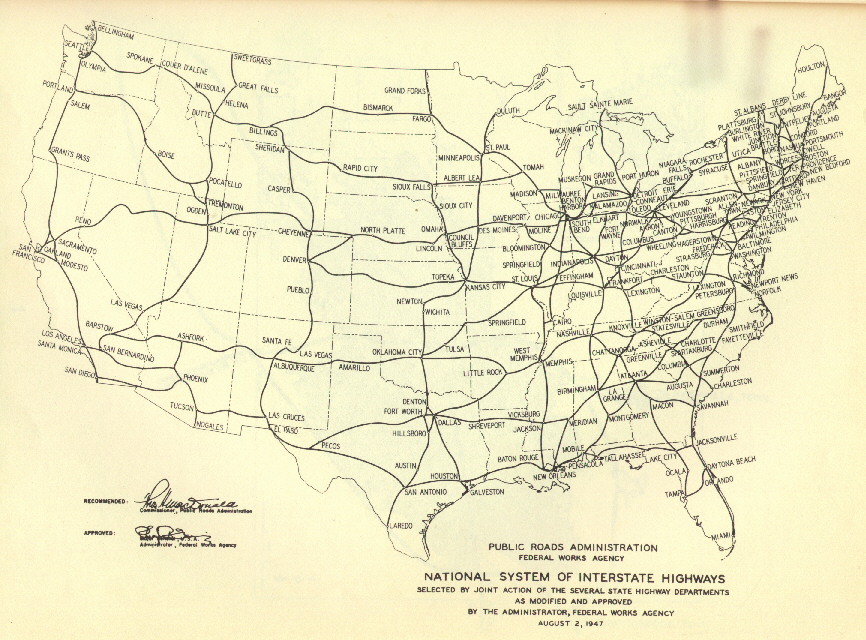
First, some history, much of it from the excellent WisconsinHighways.org site and from WisconsinHistory.org. An important anniversary largely unobserved in Wisconsin took place Sept. 4, 1958, when the first segment of Wisconsin's Interstate highways — I–94 between U.S. 18 and Waukesha County SS — opened, as pictured here.

The Interstate Highway System — created to serve "national defense; integrating the national [freeway or highway] system by filling missing links; assisting industrial, recreational and commercial movement, and 'providing direct access to, for, and from rural and urban areas,'" according to WisconsinHighways.org — is one of the few cases where Americans have gotten their money's worth from federal spending. It is impossible to imagine the American economy without the ability of independent mobility — to move goods and services from business to customer, for families to vacation somewhere other than where they live, or for people to be able to relocate through putting their stuff in their car and filling up the gas tank — without having to rely on someone else's, or more likely Big Government Brother's, schedule.

Interstates to me have always represented opportunity of mobility. I grew up one mile from where I–90 (the nation's longest Interstate, connecting Boston, Chicago and Seattle) heads south into Illinois, I–94 heads east to Milwaukee, and I–90/94 head northward. The Doppler whine of vehicles heading north or south past our neighborhood was omnipresent whenever the weather was nice enough to open the windows, particularly on holiday weekends.


The initial design of the Interstate Highway System is another example of the federal government's screwing over Wisconsin. Wisconsin has for years been considered a "2 percent state," having approximately 2 percent of the nation's population, vehicles, gross domestic product, etc. And yet Wisconsin initially was to have 1 percent of the Interstate system's mileage, with just two Interstates — I–90 from Beloit through Madison to Tomah to La Crosse, and I–94 from Kenosha through Milwaukee and Madison (along the old Wisconsin 30) to Tomah to Hudson — on the first map. (The initial plan to have I–90 along U.S. 18 between Prairie du Chien and Madison was rejected by the feds, with 90 and 94 ending up along the same route from Tomah to Madison, creating the epic Wisconsin Dells bottlenecks).

There were proposals to connect Superior and Eau Claire, Milwaukee and Marinette, and Green Bay and Hurley by Interstate, all rejected by the feds. Not until 1972 was a Milwaukee-to-Green Bay Interstate approved, with three route choices — along U.S. 41 connecting the Fox Cities, Oshkosh, Fond du Lac and West Bend; along U.S. 141 connecting Manitowoc, Sheboygan and Port Washington; and along Wisconsin 57 splitting the difference between the two routes. Ultimately, 141 was converted to what became Interstate 43, a bit of an odd decision given that more people and industry can be found along 41 than I–43.

Thanks to legislative legerdemain, Wisconsin's Interstate map has expanded over the years. I–43 was expanded southwest to Beloit along what used to be Wisconsin 15. (Don't confuse that with the new Wisconsin 15 northwest from the Fox Cities.) U.S. 51 north of I–90/94 became Interstate 39 to Wausau (and at some future point probably northward with the giant U.S. 51/Wisconsin 29 interchange project finished in Wausau). Wisconsin has three other Interstates — I–894, which runs from north of Mitchell Field to near the Milwaukee County Zoo; I–794, which runs south from downtown Milwaukee for a few miles; and I–535, which is the Duluth-to-Superior bridge.

Wisconsin also has a lot of non-Interstate four-lanes — U.S. 151 between Fond du Lac and Dubuque (which replaced a road that killed two UW Band members with whom I marched), U.S. 53 from Eau Claire to Superior, U.S. 10 from the Fox Cities to Stevens Point (and eventually westward), Wisconsin 29 from Eau Claire to Green Bay — that the state had to build (with, admittedly, significant federal money) because the feds just didn't see Wisconsin as important enough for more Interstates. Perhaps this is because Wisconsin keeps sending to Washington U.S. senators less interested in their state than, respectively, seeing Communists while being too sloppy to see if they were Communists (Joe McCarthy), insignificant examples of government waste that never challenged the size and scope of government (William Proxmire), Gaia (Gaylord Nelson), and campaign finance reform (Russ Feingold, thankfully retired by the voters Nov. 2).

The fact is that U.S. 41's inclusion in the Interstate system is long overdue. (And while we're at it, Wisconsin 441 and Wisconsin 172 between 41 and I–43 should be added too.) I–43 as the main Milwaukee-to-Green Bay connection was always insufficient in that there are no freeway connections from the more populous west side of Lake Winnebago to I–43. Interstates are the safest roads because they are designed without intersections or sharp curves and with gradual transitions from one road to the next. They are the best transportation combination of safety and freedom that man is likely to be able to design.

The Milwaukee Journal Sentinel's story attracted the usual collection of idiotic comments. One common theme is the ludicrous claim that high-speed rail is superior to Interstate travel. The mere fact that you would be traveling on someone else's schedule debunks that claim. The fact that the high-speed rail supported by the previous administration would be unusable to most of the state, not to mention freight-hauling businesses, demonstrates the elitism of the high-speed-rail set. And the quoted $15 million to $20 million to finish the upgrade project would cost less than more than $800 million for freeway speed rail, wouldn't it?

Another asks why an Interstate designation is needed — evidently written by people who do not understand the concept of marketing. The Interstate is a brand with its own brand promise — that you get at least two lanes in each direction, with no intersections, stop signs or stoplights, and that you will get to your destination as fast as your vehicle can take you and traffic will allow you. There are non-Interstate freeways, but drivers and businesses now know what Interstates give the driver, which is not guaranteed with any other kind of road.

“The Milwaukee to Green Bay corridor and the Fox Valley are major centers for economic growth and employment in Wisconsin, and the entire area deserves the infrastructure necessary to support the businesses there," said Petri, who apparently does understand how marketing works in economic development. "'Interstate' is our premier class of roads, and this region deserves no less, so I am pleased to be working with Gov. Walker on this to build our state's competitiveness and create jobs.”

A word about the number: U.S. 41 is not likely to become I–41 because state law prohibits a U.S. highway's having the same number as an Interstate. The four-lane portions of U.S. 41 northeast of Abrams still have intersections, so that part of 41 can't be in the Interstate system. (Upper Peninsula residents wondering why their parts of U.S. 41 can't be Interstate — the UP's only Interstate is I–75 from the Mackinac Bridge to Sault Ste. Marie — should ask the Michigan Department of Transportation and former U.S. Rep. Bart Stupak.) About two years ago, there were reports that U.S. 41 would become I–243, which would be considered a bypass of I–43, and which would make converting to an Interstate beside the point.


If U.S. 41 cannot become I–41, the preferable alternative would be to make it an extension of I–55, which now connects Chicago, St. Louis and New Orleans. Since Milwaukee and Chicago are already connected by Interstate (I–55 ends at Lake Shore Drive, which there is ... U.S. 41), it should be just a matter of changing signs to extend I–55 from Chicago through Milwaukee, West Bend, Fond du Lac and the Fox Cities to Green Bay. That would mean, incidentally, that I–55 would connect Soldier Field (which in the distance in this photo) and Lambeau Field.

Tuesday, May 3, 2011

Irrational exuberance


Around 9 Sunday night, I started to notice tweets that the White House was going to make an announcement at 9:30 p.m. Which made me wonder what in the world was so important that the White House couldn't have waited until Monday morning.

President Obama took so long to make the announcement that after watching nearly an hour of head-scratching on CBS and NBC, I went upstairs to send this tweet, and of course missed the speech. By then, the speech was somewhat superfluous, but the pre-speech pause gave Fox's Geraldo Rivera a chance to emote and various NBC talking heads the chance to claim that this is a great triumph for Obama.

Obama deserves credit because, rhetoric aside, how the Obama administration has handled the war on terror has been indistinguishable from how the George W. Bush administration handled the war on terror, right down to Guantanamo, secret CIA prisons, and "enhanced interrogation techniques" including, for all we know, waterboarding. It is interesting to see liberals who were squeamish about how the war on terror has been conducted, suddenly become fans of the war on terror's positive results. One of the funniest tweets from last night was an observation that Richard Nixon would have approved of going into a foreign country without its government's permission or knowledge to eliminate combatants.

My less-than-overwhelmed reaction has nothing to do with such squeamishness. (Nor does it have to do with any concern, as noted by a UW–Green Bay professor on WFRV-TV last night, over how celebrating bin Laden's death might be viewed on the "Arab street." Read Proverbs 11:10.) My opposition to the death penalty applies only to Americans. Gen. George Patton was fond of saying that the point of war was not to die for your country, but to make the enemy die for his country. (That would be the family-friendly paraphrase.) The question about waterboarding and other "enhanced interrogation techniques" is not whether they are too mean to enemies of our country, but whether they result in credible information. Apparently we have an answer after Sunday.

The people who deserve their celebration are the men and women of our armed forces, particularly those who planned and executed the mission that executed bin Laden and as a bonus acquired a great deal of additional IT-based information with the lone casualty of one of the team's helicopters. Those related to the victims of 9/11 deserve their satisfaction as well, even if one death doesn't bring back those who died on 9/11.

Osama bin Laden may be to the war on terror what Adolf Hitler was to World War II (although a more apt comparison is Japanese Admiral Isoroku Yamamoto, architect of the Pearl Harbor attack, who was shot down in a covert operation less than two years later), but the comparison ends there, because the war on terror is most certainly not over. Obama's predecessor, George W. Bush, described it early on as a long, shadowy campaign in which the victories would not be visible.

And that well describes the war on terror, in part because, due to lack of political courage or political considerations, it has never been called what it actually is -- a war by radical Islam against the rest of the world, including Muslims who don't seek the subjugation of the rest of the world. Terrorism is not unique to radical Islam, of course, but any "religion" that treats women as cattle does not deserve to exist. Liberals might notice how quickly the Obama administration became fans of the Patriot Act, opposed by liberals since its enactment during the (fill in your favorite pejorative) Bush administration. Others should notice how onerous airport security has become without actually making us safer.

I hate to use the phrase from the headline to describe the immediate reaction to bin Laden's long-overdue descent into Na'ar, Islam's Hell. Then again, what other phrase could describe the waste of electricity known as ABC-TV's "The View," whose apparent position is that the 2012 presidential election should be canceled? (I have a better idea for cancellation.)

Obama fans apparently need a history lesson:
1945: British voters reward Winston Churchill for his leadership during World War II by booting his Conservative Party, and thus Churchill, out of control of the British Parliament.
1973: The U.S. ends the Vietnam War. Less than 18 months later, Richard Nixon resigns the presidency a step ahead of an impeachment trial.
1977: Jimmy Carter engineers the Israel–Egypt peace treaty. Three years later, voters fire Carter.
1991: Operation Desert Storm ends successfully with Iraq's being forced to exit Kuwait. Less than two years later, President George H.W. Bush exits the White House.

The 2012 election will be decided by whatever voters think is happening with the economy, and, barring something bigger than what happened Sunday, nothing else. That was my opinion before Sunday night, and that is my opinion today.

Irrational exuberance is not limited only to Obama supporters. K.T. McFarland wrote at FoxNews.com:

If the Pakistani leadership in government, the military, the intelligence services decide that Al Qaeda is the weak horse, they could stop hedging their bets, stop playing their double game, and come out in support of the United States. They might clean out the Taliban safe havens in the tribal areas. If the Afghan government concludes the same, they might be willing to do what’s necessary to rally the country around their leadership, and take over more and more of the fight against the Taliban.

The war in Afghanistan is a three legged stool. One leg is the military operation on the ground in Afghanistan. The Petraeus plan has a chance of success. But the other two legs are the long term viability of the Afghan government in Kabul, and the willingness and ability of the Pakistani government to go after the Taliban safe havens in the tribal areas. Those two legs always seemed wobbly, and no stool can stand on only one leg. The death of Usama Bin Laden, so dramatically and successfully and skillfully accomplished at the hands of just 40 American SEALs, could stiffen those two wobbly legs. Then Afghanistan, like Iraq, might be a qualified success.

And, if the United States leaves Iraq this year, and starts drawing down from Afghanistan and in both cases leaves behind countries able to provide their own security, then the curse will really be lifted. And the decade of darkness will be over, and it will be morning again in America.

Those paragraphs have a lot of "ifs" -- too many ifs for that rosy scenario to take place. And none of that solves unemployment rates that have been higher in every month of the Obama administration than at any point in the George W. Bush, Clinton and George H.W. Bush administrations, plus $4-a-gallon gas (which we may remember fondly when the calendar, as opposed to the weather, indicates summer), the weak and weakening dollar, budget deficits that will never be eliminated, federal debt that will never be paid off, etc., etc., etc. And all of that is on Obama's doorstep and no one else's, whether bin Laden was sleeping with the fishes or not, because all of the aforementioned that existed when Obama got the keys to the White House has gotten worse.

Thursday, April 21, 2011

Good Friday vs. Earth Day

Friday is Good Friday, the day Christians commemorate Jesus Christ's crucifixion.

Friday is also Earth Day, in which adherents, instead of worshiping God, worship the Earth. Any Christian church that observes the 2011 Earth Day at any point this weekend is committing what the Catholics would call a "grave sin," not to mention violating the first of the Ten Commandments.

You might be able to tell that I am not a fan of the environmental movement. (As if I'm going to say anything positive about the environment after Tuesday's thundersnowsleethail.) The original goals of preserving the natural environment (see Roosevelt, Theodore) and not wasting natural resources has metastasized into bigger government, scientific bias, the opposite of free enterprise, and shunning those who dare question the followers of Gaia. Environmentalists will stick their noses in your business in such areas as whether or not you have children, your distance from home to work, your transportation choices (driving: bad; mass transit: good), and even your menu choices (meat: bad).

(For a related week-long view, go to IowaHawk.)

Ed Morrissey nicely sums up what's wrong with Earth Day:

I have nothing against Earth Day in and of itself.  While the politics of environmentalists are destructive, it’s not necessary to denigrate the efforts of individuals to help improve the environment through private and individual action. The problem with Earth Day is that it’s used as a platform to argue for statist “solutions” to environmental issues that will tend to keep people in poverty and create even more power for a small clique of elites at the top of government and big business.

Before you assume that I blithely waste natural resources: My car, purchased used, gets 25 to 27 mpg. Our house, also purchased used, is approximately one-sixth the size of Al Gore's house. If you think our having three children makes us despoilers of the planet, send me an email and I will tell you exactly where you can go. (For those who believe people are the worst thing for the planet, I suggest you improve the environment yourself by committing suicide.)

I've always been amused by publications that try to demonstrate how green they are. What is the largest single component of your local landfill? Paper. You think printing presses run on solar power? And what about the semis that get newsprint or coated paper to the press, and then after printing, gets the publications to the post office, where copies are delivered via semi or, worse, airplane, to their readers?

Author P.J. O'Rourke has the funniest and yet most prescient observation about the greenies: "Worshiping the earth is more fun than going to church. It's also closer. We can just step off the sidewalk. And sometimes we can get impressionable members of the opposite sex to perform sacramental rites with us. 'Every drop of water wasted is a drop less of a wild and scenic river, Jennifer. We'd better double up in the shower.'"

Virtue Online reposted a FrontPage Magazine story that demonstrates the religious left's confusion over what they're supposed to be worshiping, with an added misreading of the Bible:

Lent is supposed to be a season for Christians to prepare for Easter through self-denial and reflection about God. But the Religious and Evangelical Left prefer to re-orient the focus away from Christ and instead on another very different Lord: Big Government.

At a Washington, D.C. press conference, Evangelical Leftist Jim Wallis announced, along with former Democratic Congressman Tony Hall and Bread for the World chief David Beckmann, that he has begun a "water fast" to protect "selectively cruel" proposed budget "cuts" by Republican congressional leaders. ...

Former Congressman Hall was even more direct than Wallis: "We believe it's time to call in God." Hall has fasted before against proposed federal budget cuts. "A fast has to be first unto God to humble ourselves and to unleash him. Your faith is also unleashed when you struggle against injustice." But what about the "injustice" of a nation potentially trapped beneath years of trillion dollar deficits, producing a stagnant economy unable to lift the poor out of poverty, and reducing the ability of the rich and middle class to help the poor? The Religious and Evangelical Left never answer this question, because they assume that only centralized, coercive government can guarantee "justice" and provide "charity." Other social actors, like families, churches, private charities, philanthropies, and civic groups, not to mention private business, are all to submit unquestioningly to government supremacy in every human arena. Here is the Religious Left's vision of "God's Kingdom," administered from Washington, D.C. ...

Beckman and Hall also made it over to an ecumenical "prayer vigil" on Capitol Hill against federal budget cuts, dominated by old Religious Left types, like the National Council of Churches (NCC) and Mainline Protestant lobbies. One "prayer" came from NCC chief Michael Livingston: "For the poor of the earth who sustain our extravagance with their labor and whose environment we devastate with extractive industries and with our waste, may they be lifted out of poverty as we repent and make amends."

Of course, American "extravagance" provides sustenance to tens of millions of previously poor people globally whose millennia of chronic poverty were finally broken by the growth of international markets. And far more millions around the world, especially the poor, depend on "extractive industries" for their survival. Livingston's "prayer" did not explain how anybody would be "lifted out of poverty" absent the growing markets and extractive industries that fuel global economic growth. The Religious Left prefers its own grim, Malthusian myths that assume the poor can only hope for continued gruel ladled out by Big Government, domestically and internationally.

Exploiting Lent and Easter, which are chiefly about Christian hope and triumph, to perpetuate the Religious Left's depressing, redistributionist, statist assumptions seems odd.

O'Rourke also pointed out that we are able to afford an environmental move because of our prosperity. The Soviet Union and the Eastern Bloc tried mightily during the Cold War to economically outperform the West, but failed while simultaneously turning eastern Europe into a giant toxic waste dump.

Not surprisingly, the news media, which generally fails to understand religion anyway, prefers Gaia over God as well, reports NewsBusters:

Easter is the quintessential Christian holiday - the celebration of Jesus Christ's death and resurrection. Although it has been celebrated by billions of people around the world for nearly 2,000 years, the mainstream media would rather celebrate the liberal holiday known as "Earth Day" and connect Easter to the abuse scandal that surrounded the Roman Catholic Church. ...

ABC's "World News Saturday" provided the perfect juxtaposition of how the networks disparaged Easter and praised Earth Day in 2010. "This is the holiest weekend in the Christian calendar," said ABC's Dan Harris on April 3, 2010. "But Easter is providing no respite whatsoever from what may be the gravest outrage in the modern history of the Catholic Church." ...

The tone of Harris' reporting was a stark contrast to that of fellow ABC anchor Diane Sawyer's April 22 Earth Day commentary.

"And on this Earth Day we told you about the plastic lying around the earth," Sawyer said on "World News." "Well what if you could take it and turn it into an answered prayer for some children? One woman did just that. It's the American heart."

None of this justifies despoiling the environment. God gave us humans dominion over the Earth, which also gives us the responsibility of stewardship of the earth. But the number of times the environmentalist movement has gotten things wrong -- Paul Ehrlich's dreams of environmental ruin due to overpopulation, or the confusion over which kills more, DDT or malaria (correct answer: the latter) -- should make one skeptical about predictions of global warming, 30 years after predictions of an imminent Ice Age. And it takes quite a level of arrogance to assume that man is more powerful over God's creation than God.

I can guarantee you which of the two holidays will be observed in the People's Republic of Madison this weekend. (As a HotAir blogger pointed out, Earth Day is also Vladimir Lenin's birthday.)