Showing posts with label Wheels. Show all posts

Friday, May 6, 2011

Blast from the past: A wagon by any other name

First written in 2008. You will see more don't-call-them-station-wagons as you drive today.

Readers around my age have probably had some experience with a vehicle increasingly rare on the road — the station wagon.

If you were a Boy Scout or Girl Scout, or were a member of some kind of youth athletic team, or had a large dog, or had relatives approximately your age, or had friends who needed to be transported somewhere, or had parents who occasionally had to haul (either in the back or in a trailer) more than what could be fit inside a car trunk, you (or, actually, your parents) were the target demographic for the station wagon.

“Station wagons came to be like covered wagons — so much family activity happened in those cars,” said Tim Cleary, president of the American Station Wagon Owners Association, in Country Living magazine. Wagons “were used for everything from daily runs to the grocery store to long summer driving trips, and while many men and women might have wanted a fancier or sportier car, a station wagon was something they knew they needed for the family.”

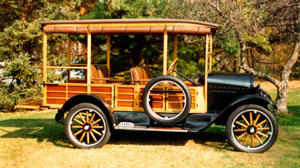
The “station wagon” originally was a vehicle with a covered seating area to take people between train stations and hotels. (“Station wagon” sounded better than the other term, “depot hack.”) The 1923 Star is recognized as the first station wagon for sale, but the 1929 Ford Model A was the first mass-produced wagon. Station wagons held more people (up to 12, depending on the size of person, in the old Ford Country Squire) and stuff than sedans, back in the days when pickup trucks, their sport utility variants, and vans were much more crude than today. The top-of-the-line wagons featured (imitation) wood siding, recalling the days when station wagons were in fact made of wood. The first ambulances were either station wagons or converted hearses, before ambulances began to be built on truck or van chassis.

Many wagons had different names from the sedans from which they originated, sounding in many cases like suburban streets or subdivisions — Beauville, Brookwood, Kingswood, Parkwood, Parkview, Colony Park, Country Squire, Town & Country, Cross Country, etc. The full-size wagons were as large as subdivisions, too. As one station wagon fan referred to a 1973 Chevrolet Caprice Estate, "5-star crash rating, meh. This beast is the crash test BARRIER. Cruise the coast, and the tide follows you."

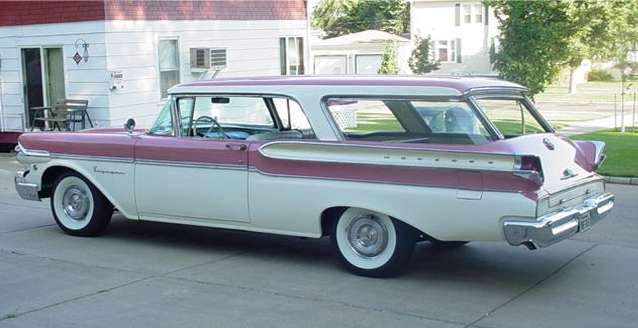
Station wagons once were popular enough to generate two books, The Ford Treasury of Station Wagon Living and Station Wagon Living Volume 2. The books, compilations of articles in the old Ford Times magazine (published between 1908 — it was targeted to Ford employees until 1946, when the focus shifted to Ford customers — and 1993), include advice on where to have everybody sleep in the wagon, including on the roof, plus your tailgate as your kitchen, the cargo area as child play area (don’t try that now, though), car seats and beds (use of which will get you a visit from the police and the child welfare people today), and all kinds of other activities you could do with or from your (Ford, Edsel or Mercury) wagon.

A few things stand out about the first volume: There is not one Interstate highway listed, although “our growing turnpike system” is mentioned. There are also no Zip codes. There are two Northeast Wisconsin manufacturers of products listed, Plantico Fuel and Dock Co. of Manitowoc, and Tomlee Carrier Co. of Oconto. The national and state park and forest map shows "Terry Andrae" (now Kohler–Andrae) State Park on "U.S. 141" south of Sheboygan (what was 141 between Green Bay and Milwaukee was changed to Interstate 43 between 1975 and 1981), Point Beach State Park on "SR 177" and "US 42" (actually Wisconsin 147 and Wisconsin 42; there is no Highway 177 in Wisconsin), Potawatomi State Park on 42 northwest of Sturgeon Bay, and Peninsula State Park on 42 between Fish Creek and Ephraim. The map also has U.S. 41 on what really is 141 north of Green Bay, which may have been a 30-year-old error.


I grew up in the generation that had a full spectrum of size choices (with or without woodgrain) for wagons, starting (photos from top) from subcompact (the late Chevrolet Vega, allegedly manufactured from compressed rust) through compact (the Chevrolet “Chevy II,” the first car I remember my parents owning) and midsize (the Ford Gran Torino, owned by a classmate of my brother’s) to full-size (including the behemoth Chrysler Town & Country, owned by the parents of a classmate of mine).


The station wagon in which I spent most of my time between ages 4 and 10 was a 1969 Chevrolet Nomad, the base Chevy midsize station wagon of the day. (Pictured is the fancier Concours. The Nomad’s only options were a 350 V-8, a two-speed Powerglide automatic transmission, an AM radio, a roof rack, and a power sliding rear window. My parents at some point purchased clear plastic seat covers for the back seat for ease of cleaning up after their children’s spills; said seat covers also heated up nicely on sunny days and left dimple marks on the back of their children’s legs.

I come from a long line of wagon owners. My grandfather (on my father’s side) owned a succession of midsize Chrysler Corp. wagons for his job as a traveling farm implement salesman — all base models (one even had the old three-on-the-tree manual transmission), and every one of them stuffed from back seat to tailgate up to the windows with sales literature. (Had he ever been rear-ended in an accident, he probably would have been decapitated by a flying overstuffed three-ring binder.) My grandparents (on my mother’s side) also owned station wagons; they blew my mind by, after asking their oldest grandson what color wagon they should buy (the LeMans Blue of the aforementioned Nomad), driving up in a new station wagon of that exact same color.


Fox’s “That ’70s Show” featured one of the ultimate wagons of the era, an Oldsmobile Vista Cruiser. (I had two classmates whose parents owned one.) The Vista Cruiser (and its companion Buick Sportwagon) was notable, of course, for the “Vista Roof,” which, I guess, allowed back-seat inhabitants to pretend they were on a Greyhound Scenicruiser. It was a cool touch, and not as weird as some other General Motors station wagon ideas, such as the clamshell tailgate of 1971–76 full-size wagons. (Instead of swinging down or to the side, the tailgate dropped underneath the bed, while the window was pulled into the roof. If this strikes you as Rube Goldberg-like needless complexity, you’re not alone; this person refers to it as “the ultimate ‘answer-in-search-of-a-question’ gadget of the ’70s.”) I’m a bit surprised that one of those Buick Estate Wagon or Olds Custom Cruiser aircraft carriers wasn’t used for “National Lampoon’s Vacation” instead of the “Wagon Queen Family Truckster,” based on a 1980s Ford Country Squire. (Then again, eight headlights could be termed “needless complexity” too.)

Studebaker had a wagon idea that worked better in theory than in practice. The 1963 Lark Wagonaire featured a retractable roof panel above the cargo area to carry cargo too long or tall to get into the wagon. Unfortunately, but not surprisingly, the roof panel leaked, and the roof panel feature also meant the third seat was not available. GMC brought back the retractable roof in its Envoy XUV, but that was discontinued after two years of subpar (as in one-third of estimated) sales.

The coolest, though not necessarily most practical, wagons of all time were built in the 1950s, beginning with the original Chevrolet Nomad. Merge a full-size station wagon with a coupe, and you have the Nomad, the Pontiac Safari, the Ford Ranch Wagon, the Mercury Commuter, the Rambler American. (Sportier versions, based on such makes as Aston Martin, Bentley and Mercedes–Benz, were known in Britain and Europe as “shooting brakes,” intended for upper-class hunters, golfers, polo players and others.) Take off the windows, and you have what was generically known as a “sedan delivery,” used by such businesses as flower shops to transport their wares.

The last of the full-size wagons — the Chevrolet Caprice and Buick Roadmaster (notice the return of the Vista Roof) — were killed by GM in 1996, when GM inexplicably gave up the entire full-size rear-drive sedan market, including police cars and taxicabs, to Ford. (GM still makes rear-drive station wagons, but in Australia, not in North America. However, Cadillac reportedly is going to sell a wagon version of its CTS sedan, which would be the first official Cadillac station wagon, although there have been some Cadillac wagons not built by Cadillac.)

Since Detroit killed off the middle- and full-size wagon (largely as a reaction to increasing fuel economy requirements), Detroit has not been successful at getting them back. Dodge’s Magnum (available with a hemi engine!) was canceled after 2008. (My neighbor has one; he likes everything about it except the limited hauling capacity and his 12 city miles per gallon.) Most station wagons are now being built by foreign manufacturers including Audi, BMW, Mercedes–Benz (would you believe an $86,000 station wagon?), Saab, Volkswagen, Volvo and of course, Subaru. The problem with these current wagons is that they have sacrificed carrying capacity for styling, so they look nice, but don’t carry that much. The closest thing to the full-sized wagon is probably the Ford Flex (in fact, Motor Trend magazine asks if the 2009 Flex is the “Country Squire for the new millennium”).

Station wagons have been largely replaced by either the SUV or the minivan, the latter which combines the efficiency of a rental storage unit with the driving excitement level of a U.S. Postal Service truck. We have a Honda Odyssey, which has six seats, power sliding side doors, and all kinds of cupholders and storage areas. If you need to get a minivan, this is the one to get.

I hate it. Or perhaps I hate what a minivan symbolizes today — you are a drone whose life does not belong to you anymore. (I would guess the I-hate-the-minivan crowd is 99.9 percent male; my wife fails to understand my attitude about minivans.) Perhaps that’s what the station wagon symbolized to our parents’ generation (most, though not all, were not very sporty); in my family’s case, the Nomad was replaced by a Chevrolet Caprice coupe, and station wagons never again leaked oil onto our driveway. Why the automakers haven’t made sportier models of minivans to get past the stigma of the cardboard box on wheels is beyond me.

I also have never been able to understand the animus toward SUVs. If you look at, say, a Chevy Tahoe, you can see that it is essentially a station wagon built on a truck chassis. SUV sales started to take off when GM (1996) and Ford (1991) terminated their large station wagons, and there are some things econoboxes can’t do, such as pull a real trailer or take your family any distance. Most big wagons weren’t exactly fuel-sippers either, but the last large GM wagons, the Caprice and Roadmaster, with the same engine that was in that year’s Chevrolet Corvette, got 24 highway miles per gallon — the same as the manual-transmission Corvette despite its superior aerodynamics.

Station wagons are making a comeback as long as you don’t call them wagons. “Crossovers” are supposed to combine the best features of minivans and SUVs (including all-wheel-drive), except that, as we now know from reading this, SUVs are nothing more than station wagons on truck frames. Ford makes the Taurus X, Edge and Flex; Chrysler sells the Pacifica; Dodge has the Caliber, Journey and Nitro; and there are a whole bunch of GM examples, even from Cadillac. (Particularly the new CTS-V wagon, all 616 horsepower of it.)
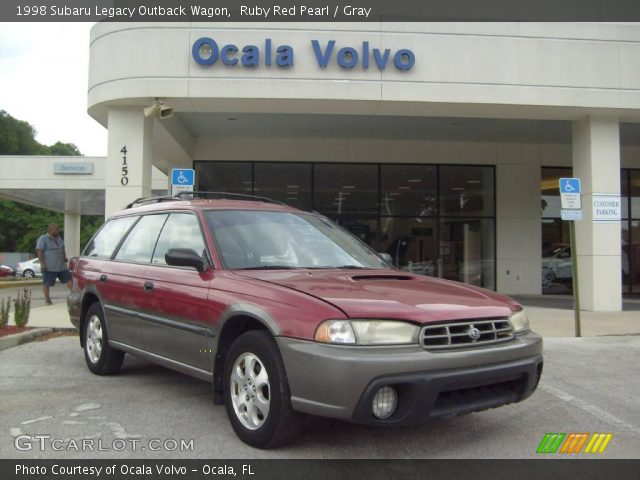


The station wagon I have is a 2005 Subaru Outback (silver), on which we have put almost 90,000 of its 140,000 miles. It is the second Outback we've owned; we put 228,000 miles on the (red) first one, with a largely trouble-free ownership experience, save for a very expensive clutch failure. (And the expense wasn't entirely about the clutch; the story involves a police car, an airport limousine ride, and a rental car, and does not include baby furniture.) After what appeared to be a catastrophic oil-in-coolant problem, we donated to Rawhide Boys Ranch, only to have someone buy the car at auction.

Outback number two is, in my opinion, better looking than its predecessor and successor models. (Our first Outback was the first iteration, our current Outback is the third, and the current Outback is the fourth.) Both Outbacks feature all-wheel-drive, Subaru's boxer four-cylinder, five-speed manual transmissions, and heated seats. (The '98 also had a weather band radio, which I wish the '05 had.) I had two unplanned off-road excursions (and one unplanned trip into a parking lot ravine) in the '98, but, thanks to the all-wheel-drive and the stick, I was able to get back on the road without use of a tow truck.
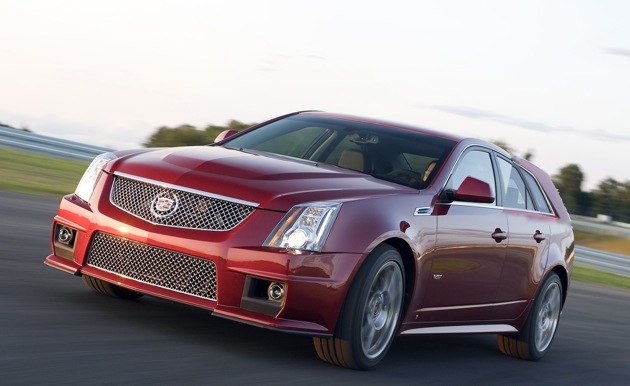

The station wagon I'd like to have is the new Cadillac CTS-V wagon, which I saw at the Milwaukee Auto Show earlier this year. It doesn't have all-wheel drive, but it does have a 556-horsepower V-8 and an available six-speed manual, which makes it the Corvette of station wagons. And a power tailgate, for what it's worth.

Perhaps my next vehicle should be one of those enormous ’60s or ’70s wagons, powered not by the emissions control-clogged engines of the day, but, say, an Allstar V-8. Trips to my kids’ sporting events would be fast indeed.

Wednesday, May 4, 2011

Interstate __

Those who follow these sorts of things know that Gov. Scott Walker's attempt to seek Interstate status for the freeway portions of U.S. 41 is not really news.

In fact, 41 between Milwaukee and Green Bay has been supposed to be slated for the Interstate system since 2005, when U.S. Rep. Tom Petri (R–Fond du Lac) inserted that stipulation into a transportation bill passed by Congress and signed into law. That is one reason for the billions of dollars of work on 41 between Oshkosh and Neenah and in the Green Bay area. Walker is seeking to have 41 changed into Interstate (fill in the number, about which more later) by 2015.


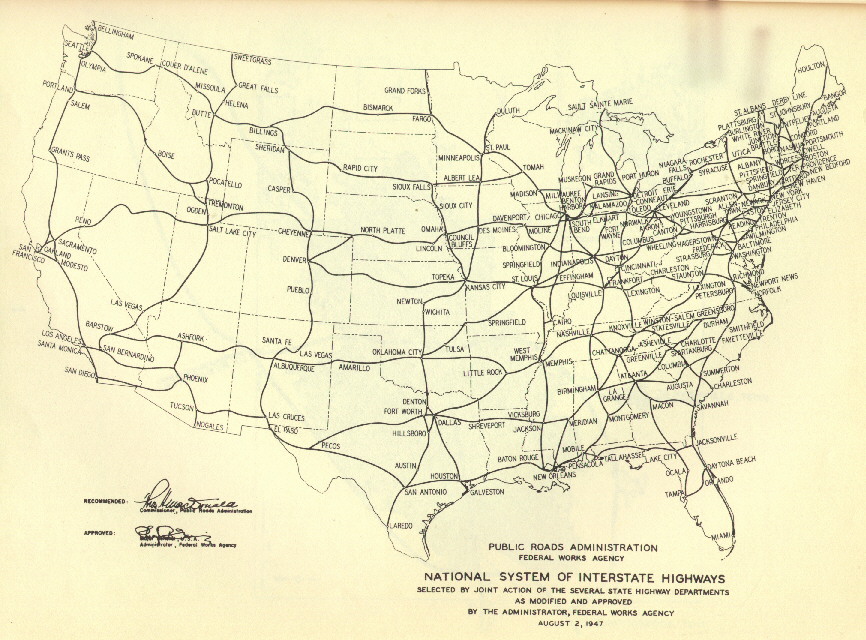
First, some history, much of it from the excellent WisconsinHighways.org site and from WisconsinHistory.org. An important anniversary largely unobserved in Wisconsin took place Sept. 4, 1958, when the first segment of Wisconsin's Interstate highways — I–94 between U.S. 18 and Waukesha County SS — opened, as pictured here.

The Interstate Highway System — created to serve "national defense; integrating the national [freeway or highway] system by filling missing links; assisting industrial, recreational and commercial movement, and 'providing direct access to, for, and from rural and urban areas,'" according to WisconsinHighways.org — is one of the few cases where Americans have gotten their money's worth from federal spending. It is impossible to imagine the American economy without the ability of independent mobility — to move goods and services from business to customer, for families to vacation somewhere other than where they live, or for people to be able to relocate through putting their stuff in their car and filling up the gas tank — without having to rely on someone else's, or more likely Big Government Brother's, schedule.

Interstates to me have always represented opportunity of mobility. I grew up one mile from where I–90 (the nation's longest Interstate, connecting Boston, Chicago and Seattle) heads south into Illinois, I–94 heads east to Milwaukee, and I–90/94 head northward. The Doppler whine of vehicles heading north or south past our neighborhood was omnipresent whenever the weather was nice enough to open the windows, particularly on holiday weekends.


The initial design of the Interstate Highway System is another example of the federal government's screwing over Wisconsin. Wisconsin has for years been considered a "2 percent state," having approximately 2 percent of the nation's population, vehicles, gross domestic product, etc. And yet Wisconsin initially was to have 1 percent of the Interstate system's mileage, with just two Interstates — I–90 from Beloit through Madison to Tomah to La Crosse, and I–94 from Kenosha through Milwaukee and Madison (along the old Wisconsin 30) to Tomah to Hudson — on the first map. (The initial plan to have I–90 along U.S. 18 between Prairie du Chien and Madison was rejected by the feds, with 90 and 94 ending up along the same route from Tomah to Madison, creating the epic Wisconsin Dells bottlenecks).

There were proposals to connect Superior and Eau Claire, Milwaukee and Marinette, and Green Bay and Hurley by Interstate, all rejected by the feds. Not until 1972 was a Milwaukee-to-Green Bay Interstate approved, with three route choices — along U.S. 41 connecting the Fox Cities, Oshkosh, Fond du Lac and West Bend; along U.S. 141 connecting Manitowoc, Sheboygan and Port Washington; and along Wisconsin 57 splitting the difference between the two routes. Ultimately, 141 was converted to what became Interstate 43, a bit of an odd decision given that more people and industry can be found along 41 than I–43.

Thanks to legislative legerdemain, Wisconsin's Interstate map has expanded over the years. I–43 was expanded southwest to Beloit along what used to be Wisconsin 15. (Don't confuse that with the new Wisconsin 15 northwest from the Fox Cities.) U.S. 51 north of I–90/94 became Interstate 39 to Wausau (and at some future point probably northward with the giant U.S. 51/Wisconsin 29 interchange project finished in Wausau). Wisconsin has three other Interstates — I–894, which runs from north of Mitchell Field to near the Milwaukee County Zoo; I–794, which runs south from downtown Milwaukee for a few miles; and I–535, which is the Duluth-to-Superior bridge.

Wisconsin also has a lot of non-Interstate four-lanes — U.S. 151 between Fond du Lac and Dubuque (which replaced a road that killed two UW Band members with whom I marched), U.S. 53 from Eau Claire to Superior, U.S. 10 from the Fox Cities to Stevens Point (and eventually westward), Wisconsin 29 from Eau Claire to Green Bay — that the state had to build (with, admittedly, significant federal money) because the feds just didn't see Wisconsin as important enough for more Interstates. Perhaps this is because Wisconsin keeps sending to Washington U.S. senators less interested in their state than, respectively, seeing Communists while being too sloppy to see if they were Communists (Joe McCarthy), insignificant examples of government waste that never challenged the size and scope of government (William Proxmire), Gaia (Gaylord Nelson), and campaign finance reform (Russ Feingold, thankfully retired by the voters Nov. 2).

The fact is that U.S. 41's inclusion in the Interstate system is long overdue. (And while we're at it, Wisconsin 441 and Wisconsin 172 between 41 and I–43 should be added too.) I–43 as the main Milwaukee-to-Green Bay connection was always insufficient in that there are no freeway connections from the more populous west side of Lake Winnebago to I–43. Interstates are the safest roads because they are designed without intersections or sharp curves and with gradual transitions from one road to the next. They are the best transportation combination of safety and freedom that man is likely to be able to design.

The Milwaukee Journal Sentinel's story attracted the usual collection of idiotic comments. One common theme is the ludicrous claim that high-speed rail is superior to Interstate travel. The mere fact that you would be traveling on someone else's schedule debunks that claim. The fact that the high-speed rail supported by the previous administration would be unusable to most of the state, not to mention freight-hauling businesses, demonstrates the elitism of the high-speed-rail set. And the quoted $15 million to $20 million to finish the upgrade project would cost less than more than $800 million for freeway speed rail, wouldn't it?

Another asks why an Interstate designation is needed — evidently written by people who do not understand the concept of marketing. The Interstate is a brand with its own brand promise — that you get at least two lanes in each direction, with no intersections, stop signs or stoplights, and that you will get to your destination as fast as your vehicle can take you and traffic will allow you. There are non-Interstate freeways, but drivers and businesses now know what Interstates give the driver, which is not guaranteed with any other kind of road.

“The Milwaukee to Green Bay corridor and the Fox Valley are major centers for economic growth and employment in Wisconsin, and the entire area deserves the infrastructure necessary to support the businesses there," said Petri, who apparently does understand how marketing works in economic development. "'Interstate' is our premier class of roads, and this region deserves no less, so I am pleased to be working with Gov. Walker on this to build our state's competitiveness and create jobs.”

A word about the number: U.S. 41 is not likely to become I–41 because state law prohibits a U.S. highway's having the same number as an Interstate. The four-lane portions of U.S. 41 northeast of Abrams still have intersections, so that part of 41 can't be in the Interstate system. (Upper Peninsula residents wondering why their parts of U.S. 41 can't be Interstate — the UP's only Interstate is I–75 from the Mackinac Bridge to Sault Ste. Marie — should ask the Michigan Department of Transportation and former U.S. Rep. Bart Stupak.) About two years ago, there were reports that U.S. 41 would become I–243, which would be considered a bypass of I–43, and which would make converting to an Interstate beside the point.


If U.S. 41 cannot become I–41, the preferable alternative would be to make it an extension of I–55, which now connects Chicago, St. Louis and New Orleans. Since Milwaukee and Chicago are already connected by Interstate (I–55 ends at Lake Shore Drive, which there is ... U.S. 41), it should be just a matter of changing signs to extend I–55 from Chicago through Milwaukee, West Bend, Fond du Lac and the Fox Cities to Green Bay. That would mean, incidentally, that I–55 would connect Soldier Field (which in the distance in this photo) and Lambeau Field.

Friday, April 15, 2011

Blast (of size) from the past: Barges on four wheels

I originally wrote this in September 2008. This explains the photo on the top right of this blog's home page.

At the Fox Cities Business Expo Tuesday, a Smart car was displayed at the United Way Fox Cities booth. I reported that I once owned a car into which trunk, I believe, the Smart could be placed, with the trunk lid shut.

This is said car — a 1975 Chevrolet Caprice coupe (ours was dark red), whose doors are, I believe, longer than the entire Smart. The Caprice, built down Interstate 90 from us Madisonians in Janesville (a neighbor of ours who worked at the plant probably helped put it together) was the flagship of Chevy’s full-size fleet (which included the stripper Bel Air and middle-of-the-road Impala), featuring popular-for-the-time vinyl roofs, better sound insulation, an upgraded cloth interior, rear fender skirts and fancy Caprice badges.

The Caprice was 18 feet 1 inch long and weighed 4,300 pounds. For comparison: The midsize Chevrolet of the ear was the Malibu, which was the same approximate size as the Caprice after its 1977 downsizing. The compact Chevrolet of the era was the Nova, which was 200 inches long — four inches longer than a current Cadillac STS.

Wikipedia’s entry on the Caprice has this amusing sentence: “As fuel economy became a bigger priority among Americans following the Arab Oil Embargo of late 1973 and early 1974, Chevy made the smaller 145 hp (108 kW) 350 cubic-inch small block V8 with two-barrel carburetor standard on all Caprice models except wagons.” That engine, 35 horsepower weaker than the previously standard 400-cubic-inch V-8, rewarded buyers with fuel economy of (I hope you’re sitting down to read this) 13 miles per gallon in the city and 18 miles per gallon on the highway. Filling up the Caprice’s 26-gallon gas tank took a big dent out of a $20 bill in its early days; few people want to ponder filling up that gas tank today. If fuel economy was your bigger priority, you were not likely to buy a Caprice anyway.

In an odd bit of GM design (and GM has been known for odd design over the years, such as the strange tailgate on the Caprice station wagon), the coupe’s trunk was larger than the sedan’s trunk. One could fit people into the coupe’s trunk, and the only problem you’d have is that the back end would hit every high-angle driveway coming and going.

The thick B-pillar (that is the part of the car between the front and rear doors on a sedan, or behind the doors on a coupe) was designed in anticipation of stiffened federal rollover standards. That was the ostensible reason as well for the death of the convertible; 1975 was the last year one could buy a Caprice, Pontiac Grand Ville, Buick LeSabre or Olds Delta 881976 Cadillac Eldorado, which was the same size as, but considerably more expensive than, the Caprice. convertible, or a Chevrolet Corvette convertible. What was thought to be GM’s last convertible was the

I haven’t asked my father why we got the Caprice, but I’d guess it was a combination of two reasons — our previous car, a 1969 Chevy Nomad wagon, had hit the 40,000-mile park in the days when cars started to experience major problems at that milestone, and he had been named an assistant vice president at the bank where he worked, so the family could afford a larger and nicer car (particularly when he put his bargaining skills to work at the local Chevrolet dealership).

The Caprice was a milestone car for our family. Younger readers probably cannot imagine that there was a day when cars didn’t come standard-equipped with air conditioning, cruise control and AM/FM radio. The aforementioned were all options, and the Caprice was our first car so equipped. (My parents declined to pay for an AM/FM stereo radio, however, or tilt steering wheel or split bench seats, which their tall oldest son would have appreciated. They also declined to pay for the gauge package containing a trip odometer, an engine temperature gauge, and a fuel economy gauge. That’s right, a fuel economy gauge — “Power” on one end, “Economy” on the other — for a car that got between 13 and 18 mpg.) My mother, who didn’t work while her sons were in grade school, used the Caprice for various errands, and that was our vacation and road car, taking us and our stuff in excellent-for-the-’70s comfort on trips to upper Michigan and Canada, Detroit, Florida and Las Vegas, the grandparents and other spots.

One year later, my wife’s family purchased a 1976 Chevrolet Impala, which was the same size but was less fancy. Those were the cars in which Jannan and I learned to drive. (Yes, they can be parallel-parked, but it’s not easy.) When I got custody of the Caprice, I used to park it in stalls in Madison parking ramps designated for compact cars.

The Caprice was a better driving experience than one might think, although it was like driving from your couch, with the wide bench seat. The engine was indestructible, though it didn’t run very well when cold, because GM hadn’t figured out how to tune cars to work with their new-for-’75 catalytic converter yet. The Caprice was no Corvette, but with radial tires and suspension to match, the car didn’t sway or rock over bumps in turns as much as some cars of the era. (I once watched an Eldorado rock for an entire block after going over a railroad crossing.) Nevertheless, the Caprice was built for comfort, not speed.

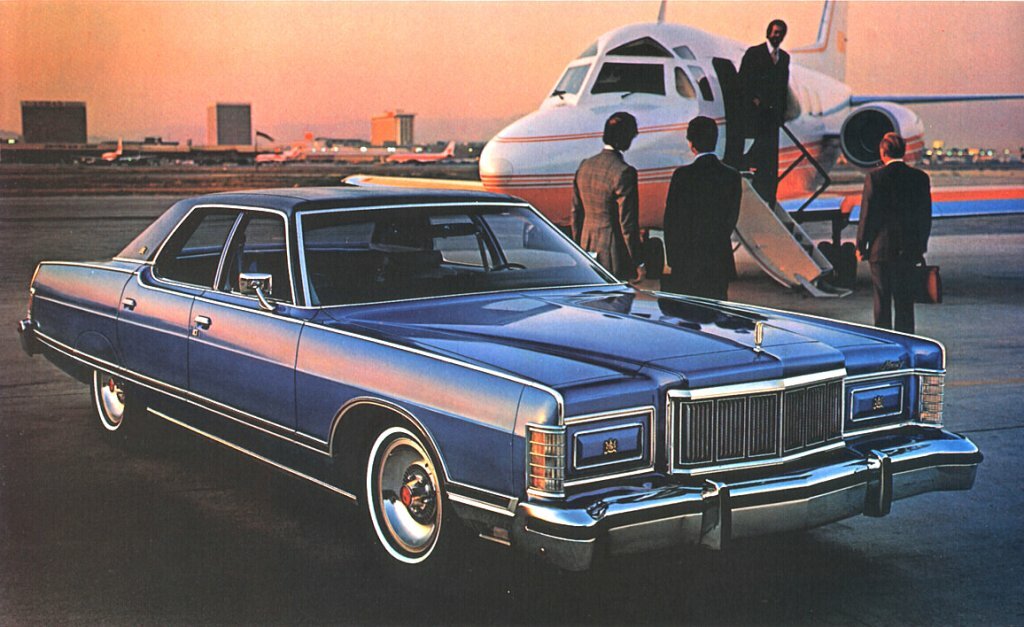
Big cars used to run in my family. My grandparents on my father’s side used to have a fleet that included a 1973 Cadillac Coupe de Ville (six inches longer and about 500 pounds heavier than the Caprice), a 1978 Lincoln Continental Town Car (the same size as the Coupe de Ville), and, for my grandfather’s farm implement sales, a Chrysler LeBaron wagon (dwarfed by the Cadillac and Lincoln since the LeBaron was based on the compact Plymouth Volaré and Dodge Aspen). My aunt and uncle on my mother’s side once owned a 1978 Mercury Grand Marquis sedan, whose size was between our Caprice and the aforementioned Town Car.

Big cars used to run in our neighborhood too. Looking up and down our street, there was a 1960s Cadillac and a 1970 Pontiac wagon next door, and a succession of Chevy Impalas for the traveling salesman one west of there (that was the house of the neighborhood Corvette owner too). The house across the street featured new Plymouths, because the house was owned by a Chrysler–Plymouth salesman. Up the street from him was a large Pontiac wagon, followed by a mid-size Plymouth wagon. The father of a friend of mine up the street sold International Harvester Travelalls. Our Boy Scout carpool included an Oldsmobile Vista Cruiser, and parents of a classmate of mine owned perhaps the largest station wagon of all time, the Chrysler Town & Country. There were no Cadillacs or Lincolns, but the cars were big because, for one thing, the families were pretty big.

Big cars used to be the only cars you could buy. “Compact” cars (which, again, were the size of today’s full-size cars) didn’t start appearing in Big Three showrooms until the late ’50s and early ’60s. (American Motors Corp. had had smaller cars before that, but that didn’t get them much traction in the marketplace.) Intermediate cars didn’t hit the scene until the early to mid-’60s. If you wanted a car into which you could fit your entire family, either to go to church or to go on a trip on the new Interstate Highway System, you bought a full-size car, whether it was a fancy Caprice or less-fancy Impala. And in an era without air bags or other safety features, size meant safety and security.

My Caprice was the next to last of an era. GM downsized all of its full-sized cars in 1977, followed two years later by Ford and Chrysler, which then got rid of its full-size cars in 1981. The traditional full-size GM cars went away in 1996, and today only the Ford Crown Victoria (which is sold only to fleets such as police departments), Mercury Grand Marquis and Lincoln Town Car are the last of the old barges. (The Crown Victoria, Grand Marquis and Town Car platform debuted in 1979.)

The newest domestic full-size rear-wheel-drive cars are the Chrysler 300 and its Dodge Charger and Magnum cousins, and the Cadillac STS, all introduced in 2005. (You may be seeing the Charger in a median strip near you or, if you’re unlucky, in your rear view mirror, since a police edition Charger is now on sale.) The Cadillac DTS is about a foot longer than the STS, but the DTS is a front-drive car.

I should have added “sold in this country” to the previous paragraph. You can still buy a Chevy Caprice, if you live in the Middle East. The current Caprice — a large rear-drive car, just like the last one built in this country — is built by GM’s Australian subsidiary, Holden, and exported to the Middle East, where they don’t worry about paying $4 per gallon for gasoline. This CapriceCapricethis writer, who I recommended earlier this week but will de-recommend if he writes another piece like this — go to “Hold Your Horsepower.”) The Australian Caprice gets 17 mpg city with the V-8, and 20 city mpg with the V-6, both of which are quite an improvement over 13 mpg. has a 360-horsepower V-8 (50 percent more horsepower than the gas-sucking 454 V-8, optional on the last huge Caprices), another reason to wonder why GM isn’t bringing this stateside.

And about that fuel economy: With the Big Three in difficulty, the Wall Street Journal’s Holman W. Jenkins Jr. suggests a way to help the automakers without spending $50 billion on them, while simultaneously getting Congress out of your car:
Look at gallons consumed, miles driven, barrels imported or emissions emitted: [The Corporate Average Fuel Economy rule] has had no significant impact on energy consumption. Its sole practical effect has been to inflict on Detroit the need to produce, with high-cost U.S. labor, millions of small cars designed to lose money.
CAFE has to be the most perverse exercise in product regulation in industrial history. It confronted the Big Three with the choice only of whether to lose a lot of money, by matching Toyota and Honda on quality and features; or somewhat less money, by scrimping on quality and features and discounting, discounting, discounting. Rationally, they scrimped — and still live under a reputational cloud in the eyes of sedan buyers. Yet notice that their profitable product lines, in which they invest to be truly competitive — such as SUVs, pickups and minivans — hold their own against the Japanese and command real loyalty among U.S. consumers. …
Had CAFE not existed, there is no reason the Big Three today could not be competitive. As businesses do, they would have allocated capital to products capable of recovering their costs. Investments in fuel efficiency would still have taken place — to the extent consumers valued those investments. That is, if they were profitable.
If Washington found this unsatisfactory, it could have done as the Europeans do and raised fuel taxes to coax the public to make different choices. Politically inexpedient? Well, yes, but that doesn’t mean CAFE is an effective substitute. It isn’t and never was.